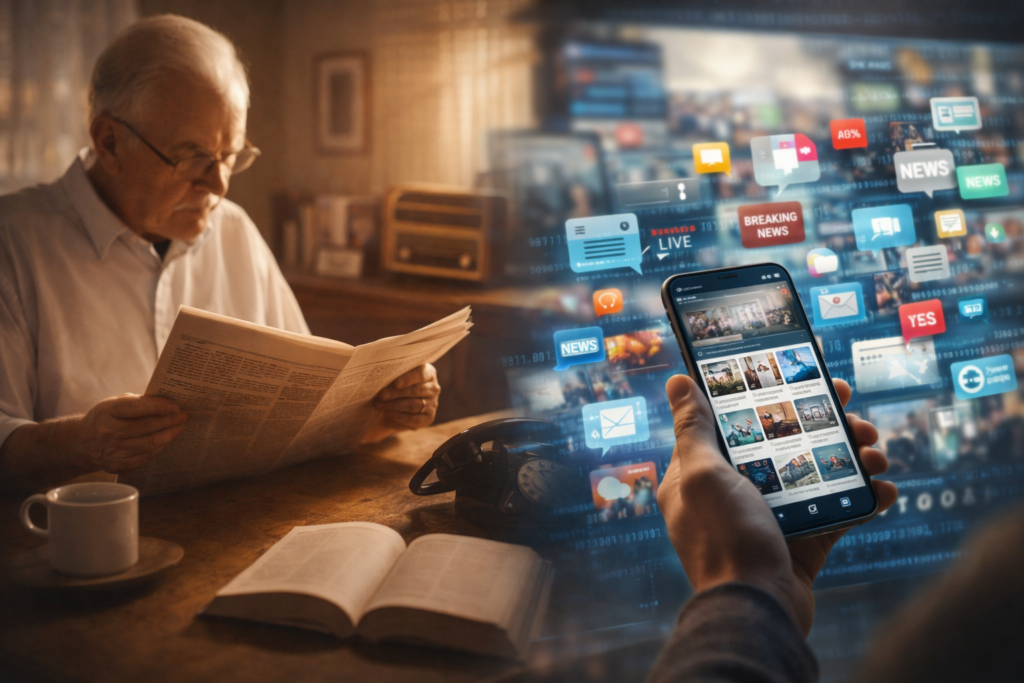
There was a time when information arrived slowly. It came through a neighbor’s conversation, a Sunday message, or the daily paper. Because it moved at human speed, we had time to absorb it, talk about it, and decide what we actually thought.
That time is gone.
Now we live in a world where the useful life of information is shrinking toward zero. We skim, react, share, and move on. We tell ourselves we’re “informed,” but much of what we carry isn’t knowledge at all. It’s stimulus. It’s emotion. It’s programming.
We once called this progress the “Information Superhighway.” The phrase sounded confident, even heroic.
But maybe the better question is: where has this road taken us?
From Checkers to Chaos
Long before smartphones and 24-hour news, we saw early signs of the shift. In 1952, Richard Nixon, under pressure to step aside as Dwight Eisenhower’s running mate, turned to the emerging power of television with what became known as the “Checkers” speech. It wasn’t just a defense. It was a strategy: bypass the traditional gatekeepers, bypass the press, and speak directly into living rooms with an emotional appeal.
That moment mattered because it proved something to every future candidate: if you can master the medium, you can reshape the message. The media was no longer just the messenger. It had become part of the battleground.
Listen to the moment the rules changed. If you’ve never heard the “Checkers” speech, it’s worth a few minutes, not because of the dog, but because of the method. This is one of the earliest examples of a politician using a mass medium to go around the filters and speak straight into the public’s emotions and trust. What we now call “direct-to-audience messaging” didn’t begin with social media. You can hear it forming right here.
Two years later, the McCarthy hearings, broadcast live in 1954, transformed political conflict into public spectacle. For the first time, millions of Americans didn’t just read about power. They watched it. And once politics becomes performance, the pressure to “win the moment” starts competing with the obligation to tell the truth.
The media noticed. Politicians noticed. And the rules began to change.
Journalism Turns a Corner
For decades, journalism held itself to a basic standard: verify before publishing, protect sources, stay out of the story, and treat facts as sacred. Those standards didn’t always hold perfectly, but they were the ideal.
Then incentives shifted.
By the 1970s, Watergate showed what investigative reporting could accomplish when it was done with discipline and courage. But even then, a quieter reality emerged: scandal attracts attention, attention attracts profit, and profit reshapes behavior. The watchdog could become a celebrity. The newsroom could become a stage.
When CNN launched 24-hour news in 1980, the old rhythm disappeared. The news cycle didn’t reset each morning. It had to be constant. And when content must be constant, urgency becomes a product. If there isn’t a crisis, the temptation is to stretch one, frame one, or manufacture the feeling of one.
The goal drifts from clarity to engagement.
And when engagement becomes the goal, truth becomes negotiable.
Conditioning the Mind, Thinning the Family
This doesn’t just change how we think. It changes how we relate.
Families used to sit together and talk. Then the television became the background pulse of the home. Conversations shrank. Attention fragmented. Fear found a permanent seat at the table.
Eventually we stopped asking, “Is this true?” and started asking something far more dangerous: “Does this confirm what I already believe?”
In the 1980s, I was contracted by a law firm to write Parents Guide to the Information Superhighway. Back then the internet was only beginning to show its teeth. The technology was primitive compared to today, but the direction was already visible. I warned that unless we taught our children how to think critically, how to know themselves, and how to build meaningful in-person relationships, they would become increasingly fragmented, manipulated, and emotionally unmoored.
I wasn’t trying to scare anyone. I was trying to prepare them.
Most people chuckled.
The Fog of Now
Decades later, we’re living inside the consequences.
We’re surrounded by information, but starving for wisdom. We curate identities instead of forming character. We let political memes dissolve family bonds. We replace discussion with personal attack. We absorb the framing of a host or the editing of a viral clip and mistake it for truth.
In a strange way, we’ve trained ourselves to become predictable. Not because machines are taking over, but because too many of us have stopped doing the hard work of discernment. We don’t just consume information. We are shaped by it.
What’s at Stake
Families are splitting, not only physically but emotionally and ideologically. Churches often preach but do not teach. Schools measure but don’t necessarily equip. And government, never designed to parent a society, steps into the vacuum when families and communities step back.
We don’t need more censorship.
We don’t need a new set of speech police.
We need something deeper.
We need the equivalent of a license to drive the information highway, because right now we are letting the most powerful forces in society steer our minds without asking for permission.
So what would that “license” actually require?
It would require learning how to think again, starting with the humility to question not only others, but ourselves. It would require a return to inner formation, knowing who you are apart from likes, outrage, and tribal approval. It would require recognizing that attitude and belief drive behavior, and asking whose beliefs you’ve been carrying without examination.
It would require building a foundation: purpose, principles, and a chosen pathway. Without that, you drift, and drifting is exactly what the system trains you to do.
It would require forming relationships after identity, not before it. When you don’t know who you are, you’ll attach to anything that makes you feel safe, and you’ll call it belonging. When you do know who you are, you can choose partners—personal, spiritual, professional—who reinforce your best self rather than your most reactive self.
And it would require parents, families, and communities to become intentional again. Not perfect, intentional. A family culture that protects conversation. Accountability that teaches character. Shared moments guarded with the same seriousness we give to passwords and screen locks.
What Now?
We can’t regulate our way out of this.
We can’t return to 1952.
But we can choose to step off autopilot.
We can choose to become whole again, not only as individuals, but as families, as communities, as a people. That’s social work, yes. But it’s also spiritual work, because the core question underneath all of it is personal:
Am I thinking for myself?
Or am I reacting the way I’ve been trained to react?
This isn’t just an information crisis.
It’s an identity crisis.
And the only way forward is inward.
If you want to go deeper, I invite you to explore 21st Century Tribal Boundaries and Survival in the 21st Century, books not about politics or platforms, but about reclaiming human presence, spiritual truth, and quiet courage. Click the covers below to see more about that book.