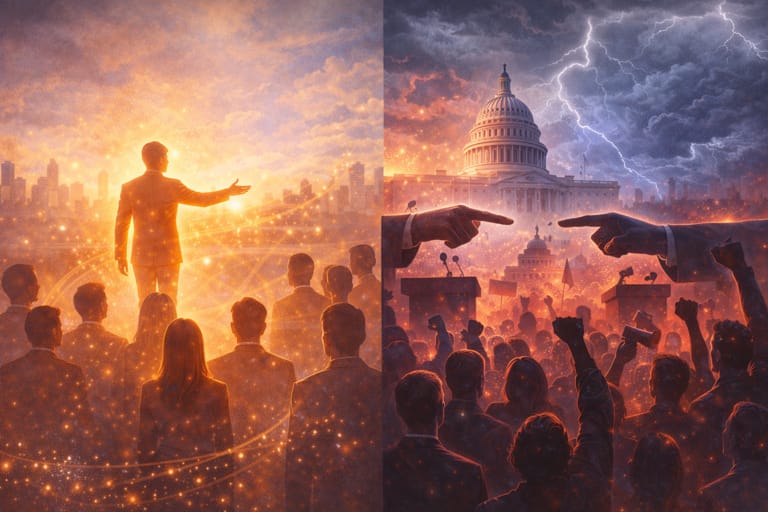
There is a reason the phrase political leadership can sound like a contradiction. Not because leadership is impossible in politics, but because the modern political environment often rewards something else.
Leadership and administration are not the same thing.
Administration is execution. It is managing systems, moving resources, enforcing rules, and producing measurable results. Administration is what keeps the lights on and the roads paved. When it works well, daily life holds together.
Leadership is different. Leadership is cultural. It shapes what people believe is acceptable. It influences whether a society becomes more honest or more cynical, more cooperative or more tribal, more compassionate or more hardened. Leadership does not just decide what gets done. It sets the moral atmosphere in which things get done.
A healthy nation needs both. But when politics becomes dominated by administration and performance, leadership fades. And when leadership fades, the culture begins to degrade.
The Real Problem Isn’t Left or Right
Here is the trap many people fall into: they think the problem is the other side.
It isn’t.
The deeper problem is that politics has increasingly become a system built for winning rather than leading. The goal becomes staying elected, controlling the narrative, and sustaining allegiance. In that environment, truth becomes flexible, outrage becomes useful, and compromise becomes suspicious. It does not mean every politician is corrupt. It means the system rewards behavior that looks less like leadership and more like survival.
That is why so many citizens feel exhausted. The public is not just watching disagreement. The public is watching a culture being shaped in real time, and it is often a culture of mistrust.
Why Civics Matters Here
When people become discouraged, they sometimes seek simplistic answers. One of the most common is, “This is a democracy, so the majority should rule.”
But the United States was never designed as a pure direct democracy.
It is a representative republic, which means citizens elect representatives to do the work of governing. It also means the system is built with restraints: a constitution, separation of powers, checks and balances, and protections for minority rights.
Those restraints exist for a reason.
A direct democracy can drift toward mob rule. A republic, when healthy, slows that down. It forces debate, negotiation, and limits on authority. It tries to protect the individual from the passions of the moment.
But that only works when citizens understand the design and demand that leaders honor it.
A republic cannot survive on autopilot.
When Leadership Fails, Administration Turns Into Control
Here is what happens when leadership is weak.
Administration keeps running, because the machinery never stops. But without leadership, administration becomes controlling rather than guiding. It becomes focused on compliance instead of conscience. It leans on rules, pressure, messaging, and enforcement because it no longer has trust.
And trust is the real currency of leadership.
When trust erodes, people stop listening. They stop thinking. They retreat into tribes. They choose information that comforts them instead of information that challenges them. That is not just political decline. That is cultural decline.
What Political Leadership Should Look Like
If leadership is cultural, then political leadership should be measured by cultural outcomes, not just policy wins.
Political leadership should do things like:
Tell the truth even when it costs votes.
Admit uncertainty when certainty would be dishonest.
Protect the rights of people you disagree with.
Treat opponents as fellow citizens, not enemies.
Encourage critical thinking instead of demanding loyalty.
Raise the tone of the nation instead of profiting from division.
That kind of leadership is rare, not because it is impossible, but because it is hard. It demands courage. It demands restraint. It demands a willingness to lose short-term advantage for long-term integrity.
The Citizen’s Role: Demand Leadership, Not Theater
Most of us are not in office. But we are not powerless.
A republic depends on citizens who refuse to be manipulated.
That means learning to spot performance. Learning to recognize when you are being emotionally steered. Learning to ask better questions:
Is this person building trust or harvesting anger?
Are they solving real problems or feeding the outrage machine?
Are they inviting thought, or demanding allegiance?
Are they strengthening the country, or just winning the moment?
Politics will not improve until the public stops rewarding the behaviors that degrade the culture.
A Practical Way Forward
We don’t need more shouting. We don’t need more censorship. We don’t need a new tribe.
We need reforms worth debating, but we also need something even more foundational: a cultural return to integrity and critical thinking.
We should be willing to discuss ideas such as campaign-season limits, spending transparency, stronger ethics enforcement, and clearer guardrails against conflicts of interest. Not as partisan weapons, but as civic maintenance. Like repairing a bridge before it collapses.
Because this is not just a policy crisis.
It is a leadership crisis.
And leadership, in the deepest sense, is not the ability to win arguments. It is the ability to shape a culture in which truth matters, in which people remain human toward one another, and in which the country becomes more whole rather than more fractured.
In a republic, that responsibility does not belong only to politicians.
It belongs to all of us.