There are times when I look at life and feel something settle in me that doesn’t come from logic alone. It’s not an argument. It’s not a doctrine. It’s more like a quiet recognition.
A sky full of stars. The scale of galaxies. The hidden order inside a seed that becomes a tree. The way a child’s smile can soften a hard day. The strange reality that love and compassion can move through human beings at all.
I can’t prove God like a math equation. I’ve never had God sit down across the table and speak in a voice I could record. And I understand why some people, especially practical people, struggle with belief. We are physical creatures. We want physical certainty. We want something we can measure, photograph, or hold in our hands.
But here is what I have learned about myself: when I try to force the world into a purely accidental explanation, I have to suspend more reason than when I accept the idea of a Creator. The deeper I look—both outward into the vastness of the universe and inward into the microscopic building blocks of matter—the less satisfying the “it all just happened” explanation becomes.
And yet, I also understand why people wrestle. Some don’t reject God so much as they reject what they have seen done in God’s name. They’ve watched religion become a gavel instead of a guide. They’ve watched people use scripture to control, shame, divide, and condemn. Others struggle because they see disagreements everywhere: denominations, interpretations, translations, arguments about which version is “right,” which tradition is “pure,” which group holds the exclusive key to truth.
I get it. I don’t think honest questions are the enemy.
What worries me is something else: when the questions become a hiding place. When a person gets so caught up in analyzing the details that they never move forward into the actual spiritual life—never into love, never into transformation, never into compassion, never into becoming whole. At that point, “seeking truth” can quietly turn into a way of staying unchanged. And that is not the point of faith. That is not the point of spirituality. A spiritual life that never produces a different way of living is like a recipe that never becomes a meal.
That is why I want to tell you a story. Not a sermon. Just a story that captured something in my own mind and has stayed with me because it speaks to what I’ve watched happen for years.
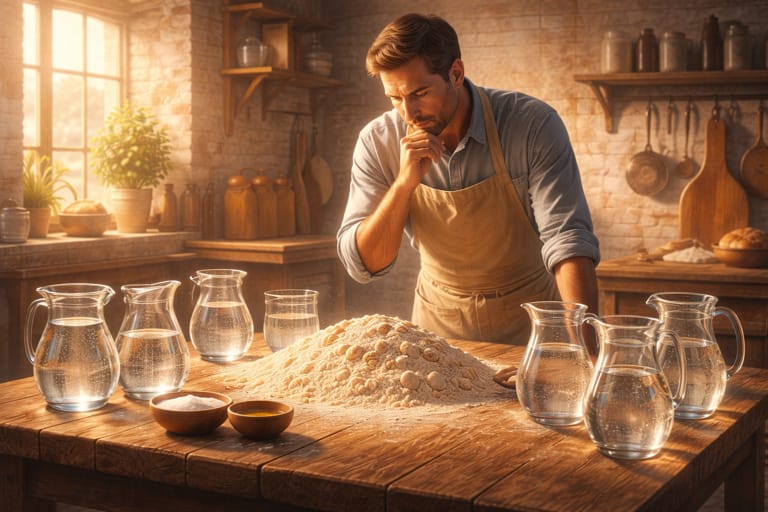
In the story, a man stands at a table with everything he needs to bake a loaf of bread. Flour. Yeast. Salt. The ingredients are there, measured and ready. But there is one thing missing—water. Without it, nothing combines. Nothing rises. All the ingredients remain separate pieces, never becoming what they were meant to become.
As the man stands there trying to decide what to do, another man walks up carrying eight pitchers of water. He sets them down around the table, almost like points on a compass, and asks, “Would this help you?”
The baker looks at the pitchers and says, “Yes. Any one of those would work.”
The man smiles, and then he asks a question that seems simple, but suddenly isn’t: “Then which one will you choose?”
The baker hesitates. “Aren’t they all the same?” he asks.
“Oh no,” the man replies—and he begins pointing from pitcher to pitcher, explaining the differences. One came from the south and carried minerals not found in the others. One came from a spring deep within the earth. Another passed through stone, shaping it in subtle ways. He goes around the table, explaining how each pitcher of water is different in its own way.
Then the man says something that changes the entire moment.
“For each pitcher,” he tells the baker, “there is someone who insists it is the only true water. They will praise their pitcher and condemn the others. They will argue, divide, and claim superiority. And yet, any one of these pitchers contains what you need to bake bread. Once the loaf is baked, most people won’t be able to tell which pitcher you used. But if you stand here analyzing water forever, you will never bake anything.”
The baker looks back at the flour and yeast. He looks at those waiting for a loaf. And he realizes the truth of it: he can spend his whole day debating the purity of water and never feed anyone.
So he says, “If I keep analyzing this, I’ll never make bread.”
The man nods. “Exactly. Choose the one that helps you begin. Bake wisely.”
And the baker finally pours.
The yeast rises. The ingredients come together. What had been scattered becomes whole. And the loaf becomes what it was meant to become.
That story has always felt like a picture of the spiritual life.
People can spend their entire lives arguing about containers—labels, denominations, versions, rulebooks, who is right, who is wrong, who is in, who is out. And meanwhile, the loaf never gets baked. Nothing rises. Nothing becomes whole. Nothing changes.
I am not saying beliefs don’t matter. They do. I’m saying the purpose of spiritual truth is not to win arguments. The purpose is transformation. The purpose is a life that slowly becomes more loving, more grounded, more honest, more compassionate, more courageous, more free.
That is why I do not treat the Bible like a weapon or a gavel. I treat it as a guide. A guide is not there to control you. It is there to call you forward. It warns you when you drift. It challenges your ego when pride tries to lead. It reminds you that fear is not meant to be your master. It calls you back, again and again, to what is higher.
And I believe the “water” of truth is not meant to be studied endlessly while we refuse to live it.
If our spiritual life never produces love, patience, integrity, humility, compassion, and courage, then we are not baking bread. We are polishing our pitchers. We are defending our labels. We are proving we are right—but we are not becoming better.
There is another part of this that matters to me, and it might be the part that makes some people uneasy: I don’t believe I have to condemn another person’s pitcher to bake my own loaf. People are different. Cultures are different. Wounds are different. Some forms of religion have harmed people. Some have healed people. Some have inspired courage. Some have produced control.
But the question that matters most is not, “Can I win the argument?”
The question is, “Is the bread rising?”
Is your life becoming more loving?
More honest?
More grounded?
More compassionate?
More courageous?
More whole?
Because if we never pour the water, nothing changes.
And if you are the kind of person who needs every detail resolved before you begin, I understand. But I will tell you what I have learned, and I say this gently: you can spend your whole life analyzing ingredients, and never feed anyone.
Or you can begin.
You can take what is true, what is life-giving, what calls you toward love and wholeness, and you can pour it into your life. Not to control others. Not to prove you are superior. Not to win a debate. But to become the person you were meant to become.
Bake the bread.
Don’t spend your life arguing about water.