What if your spirit isn’t something you have to find, but something you’ve always had?
That question lands differently depending on where you’ve been in life. Some people carry a deep religious history and a lot of mixed feelings about it. Others have never been drawn to religion at all, yet still admit something quietly persistent inside them. And many, if they’re honest, live in a strange tension: they accept that there is “something more,” even while denying the existence of God as they’ve been taught to define God.
I’ve heard that confession more times than I can count.
It usually comes out gently, almost apologetically, like they’re unsure they’re allowed to say it. They don’t want a debate. They don’t want a label. They just know there are moments when life feels bigger than the physical world, bigger than biology and time and routine. Moments when they sense a presence, or a nudge, or a quiet awareness that refuses to be explained away.
And that awareness helps them keep going.
It steadies them when grief shows up. It gives them strength when the facts don’t look good. It brings comfort that doesn’t seem to come from logic. It is as if something is built into us, something that reaches beyond the visible world toward the unseen.
Call it spirit. Call it conscience. Call it intuition. Call it the quiet voice within.
But don’t dismiss it too quickly.
Because what I’ve come to believe, after listening to so many people and after walking my own path, is that the spiritual dimension of a person is not a prize reserved for the “religious.” It’s part of being human. It’s not something handed out to a few. It’s something already alive within each of us, waiting to be noticed, trusted, and lived from.
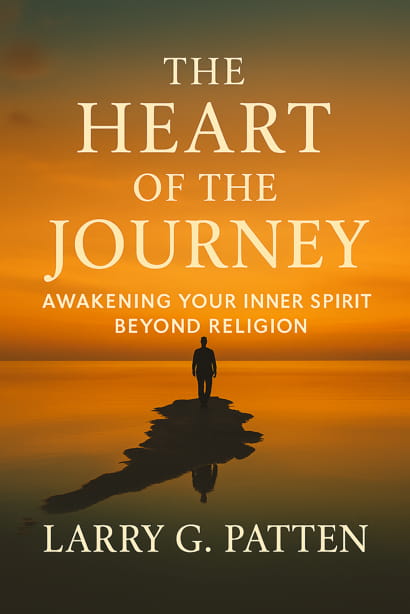
That’s the heart of what I wrote about in my book The Heart of the Journey.
It doesn’t try to win arguments or build a case. It doesn’t ask you to perform your way into acceptance. It simply invites you into a deeply personal journey of rediscovering the sacred presence already living inside you. Not a doctrine. Not a checklist. Not a religious identity. A relationship. An awareness. A sense of connection that doesn’t require fear or perfect certainty to be real.
In a world obsessed with certainty, we’ve been trained to distrust anything that can’t be proven on demand. Yet some of the most important things in life are not measurable. Love. Meaning. Conscience. Hope. The inner pull toward goodness. The ache to belong. The sense that we are more than the roles we play.
Those aren’t weaknesses. They’re signals.
The question is whether we learn to listen.
Many of us were raised with inherited religion, and some of that inheritance was beautiful. Some of it was harmful. Some of it created fear where there should have been peace. Some of it made people think spirituality is something controlled by institutions rather than something cultivated in the human heart.
But spirit isn’t owned by religion.
And your path doesn’t have to look like anyone else’s.
In The Heart of the Journey, I explore the difference between inherited religion and personal faith, and how a person can move beyond ritual into something more real. I talk about trusting spiritual intuition in a culture that tries to shame anything that doesn’t fit a neat formula. I talk about what it means to be a spiritual champion in daily life, not as a title, but as a way of living from authenticity. And I talk about the seasons we all face, the silence, the doubt, the feeling of distance, and how those seasons don’t have to mean you’ve lost your way.
Sometimes they’re part of the way.
This is not about religion.
It’s about spirit.
Your spirit.
And what happens when you finally stop chasing approval, stop performing for acceptance, and start listening to the quiet presence that has been with you all along.
If any part of this resonates with you, I invite you to explore the book here: