Some people say that belief in God is unreasonable. They describe it as myth, a story invented by humans to comfort themselves in a harsh world. I understand why they say that. God has never physically sat at my table, poured a cup of coffee, and explained the mechanics of existence. And because we are physical creatures, we naturally crave physical proof. We want something we can hold in our hands, measure, and label.
But there comes a point where demanding that kind of proof begins to feel like the wrong question.
Because when I look at what is, the more unreasonable position, at least for me, is the claim that all of this came from nothing.
I’m not talking about the religious version of God that some people have been taught. I’m talking about something more foundational: a Creator, a Source, the presence behind existence itself. I use the word God because it’s the word people recognize, but in my mind it points to the Creator of everything, not a narrow caricature defined by human institutions.
When I look at the universe, I do not see emptiness. I see design, interconnection, and staggering depth.
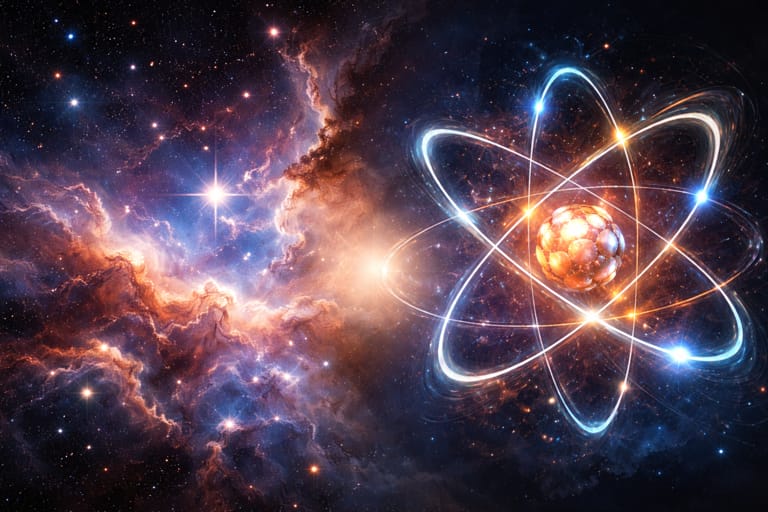
When I look at the pictures coming back from the James Webb Space Telescope, I see structures so vast and beautiful they almost seem impossible to exist. Those images don’t prove God in a courtroom sense, but they do something else. They awaken awe. And awe, to me, is one of the most honest human responses. It’s the feeling we have when our intellect reaches its edge and something deeper inside us says, “This is more than accident.”
Then I look the other direction, toward the micro world.
Everything around us appears solid, but it’s built out of compounds, made of elements, composed of atoms, held together by forces we cannot see. And then you look closer and realize atoms are mostly space. You find particles that behave like waves, waves that behave like particles. Reality itself becomes stranger the closer you examine it, as if the universe is not merely a machine but something far more mysterious.
It reminds me of a child dumping a box of LEGO pieces on the floor. At first it’s just scattered parts. Random pieces. No meaning. No structure. And then, somehow, there’s a castle. A working drawbridge. Towers. Symmetry. Purpose.
You can call it a metaphor, but the point stands: the movement from scattered pieces to coherent structure requires explanation. “It just happened” is not an explanation. It’s an evasion.
The same is true when I look at the human life.
I can move my fingers with precision while my lungs breathe on their own, my heart pumps blood without asking my permission, and billions of biological processes run constantly in the background. I don’t direct them. I barely understand them. Yet they function with astonishing coordination. I can speak a thought and translate it into sound. I can remember. I can love. I can choose compassion even when anger would be easier.
There’s a quote often attributed to Einstein that I’ve always liked: “There are only two ways to live your life. One is as though nothing is a miracle. The other is as though everything is a miracle.”
I don’t use that line to avoid science. I use it to keep my eyes open. The fact that I can pick up a cup with my fingers while I’m speaking, breathing, and thinking is a miracle of coordination and life. The fact that we live on the edge of an enormous galaxy, and can look into the sky with both awe and understanding, is a miracle of consciousness. You can call it biology. You can call it physics. I call it astonishing. And the more astonishing it becomes, the harder it is for me to accept that nothingness is the final explanation.
If I try to adopt the doubter’s philosophy that all of this simply happened, I run into a wall. Not because I reject science. I don’t. Science describes how things work. But “how” is not the same as “why,” and it certainly is not the same as “from where.”
To believe that everything emerged from nothing requires a suspension of reason far beyond my capability.
People will say, “But the Big Bang explains it.” It explains a moment of expansion. It describes an event. But it doesn’t escape the deeper question: where did that event come from? Why was there anything to explode in the first place? Why laws? Why order? Why mathematics that holds? Why a universe that can be understood?
Even if you begin with a bang, you still have to explain the match.
And when people say belief in God is unreasonable, I understand the concern. But from where I stand, belief in pure causality without a catalyst is the greater leap. It is like claiming a great painting arrived without a painter. It is like claiming a symphony assembled itself, note by note, into beauty.
And beyond the physics, there is the part that presses hardest on me: love.
I can describe chemical reactions and brain activity all day long, but no physical explanation fully captures the moral weight of compassion, the ache of grief, the fierceness of devotion, or the reality that human beings can choose sacrifice, mercy, and forgiveness even when it costs them. If love is nothing more than the random bouncing of particles, then meaning itself is an illusion. And yet we live as if meaning is real. We build our lives on it. We suffer for it. We die for it.
That is not randomness. That is something deeper.
So no, I don’t feel the need to argue endlessly over whether God intervened, or exactly how creation unfolded. Those debates can become distractions. The evidence of a Source is around us every day, in both the vastness above and the intricacy within, and right here in the middle where we live our lives.
For me, the real suspension of reason would be looking at all of this and saying, with a straight face, “Nothing did it.”
I can’t do that.
Not honestly.
Not with what I see.
Not with what I am.
Not with the quiet awareness that something greater than me is present in it all.
This is why I don’t see faith as a suspension of reason. I see it as reason arriving at a horizon. Science can describe processes with brilliance, and I value that. But explanation is not the same as origin, and mechanism is not the same as meaning. At some point, the honest response to what we see—macro, micro, and right here in the middle—is not arrogance, but humility. For me, it takes far more mental gymnastics to believe that everything came from nothing than it does to believe that existence has a Source. That isn’t blind belief. It’s reverence for the evidence that surrounds us every day.