And then there are the ones that land in your chest and stay there, because they don’t feel like entertainment. They feel like a mirror.
“Spiritual Warfare” by Bon Jovi is one of those. It’s an emotional portrait of two different worlds living side by side, and it quietly asks a question that cuts through politics, religion, and all the labels we use to keep distance from each other:
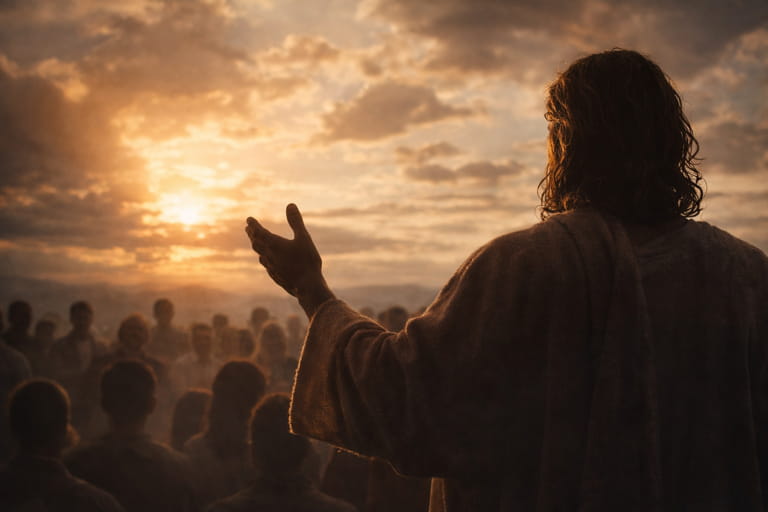
Jesus didn’t warn us about false prophets because he wanted us to be suspicious of everyone. He warned us because he understood something about human nature: when we feel afraid, uncertain, or overwhelmed, we become desperate for simple answers. And in those moments, we are most vulnerable to voices that sound confident but aren’t grounded in truth.
That’s why his words still matter. They aren’t just religious instruction. They are a survival guide for the inner life.
Some nights I step outside and look up long enough that the noise in my head finally loses its grip. The sky has a way of doing that. It reminds me how large everything is, how old everything is, and how little control I actually have. I see the stars and I think about what we now know is out there—black holes, neutron stars, galaxies moving through darkness like slow ships. Distances so vast they don’t feel real until you let the silence sink in.
Then, almost without warning, my mind flips to the other universe—the one underneath everything. The microscopic architecture that holds the world together. Particles, waves, forces, atoms. The invisible scaffolding of reality that never pauses and never loosens. And what stuns me every time is that these two worlds—the enormous and the tiny—aren’t separate. They are one continuous fabric. The smallest things build the largest things. The micro becomes the macro. And somewhere inside that seamless chain of existence is us.
Faith is one of the most misunderstood powers in a human life because we treat it like a feeling. We talk about “having faith” the way we talk about having hope, or having a good attitude, as if it’s something that visits us when circumstances are calm and leaves when life gets hard.
Leadership is one of the most overused words in our culture. We attach it to titles, positions, and roles, as if leadership is something a person becomes the moment they are promoted or placed in charge.